
Trust is such a vital topic in any workplace, for anyone in any role, in any industry. We strive to do the best possible work we can, under a range of challenging contexts, and in order to do our best work, we need to have the trust of our peers, our managers and our leaders. If we haven’t built up trust then it makes our task in hand much harder to achieve, sometimes impossible, if we are having to navigate a minefield of internal politics, conflict, push back, laborious demands, etc. Not having trust makes any kind of decision making so much harder – that scenario of not having the environment to disagree but still commit. That only comes when everyone is seen to be trying to do the right thing, and they all have that “one team” mentality – which is all built on trust.
But how exactly do you build trust? What are the key triggers that cause people implicitly or tacitly to start trusting others?
This is something I’ve been putting some deep thought into for the past few years, and I’ve distilled my views from this deep thinking and some experimentation around my ideas into a model, which I’m calling the “Cycle of Trust”. The model of course consists of some sub-models, which relate to: 1) the pathway of proficiency growth, 2) the lifecycle of impact and value, and 3) methods for showing your impact/value. These three things majorly affect growing trust., which in turn then creates more opportunity for you to improve your proficiency, in turn improving your ability to make a bigger impact, which you can keep making transparent, growing trust further, and the loop continues.
The Proficiency Growth Cycle
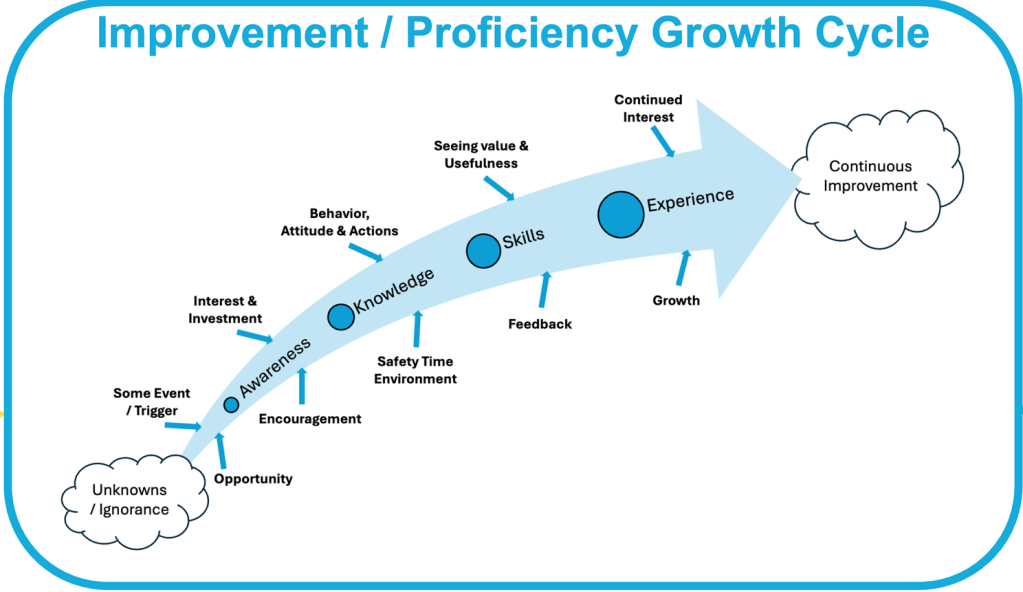
Brothers, Stuart and Hubert Dreyfus, first published the Dreyfus Model of Skills Acquisition in a white paper in 1980, then again in their book “Mind Over Machine” in 1986. Their model proposed 6 skill acquisition levels of: novice, advanced beginner, competence, proficiency, expertise, and mastery. In my own experience, through working in a range of tech senior leadership roles over the past 10 years, the starting point is rarely at the “novice” proficiency level. There are many topics I’ve tried to teach about and form strategies around implementing, where the people I’m speaking to have had a lack of awareness of the topic completely (some common examples are things like various testing approaches like Exploratory Testing, or topics like Continuous Compliance – yes it’s completely possible to align regulatory documentation creation with Agile and CI/CD practices to still be able to release multiple times per day!).
So with this in mind, the starting point for my proficiency growth cycle had to be that fluffy cloud of unknowns / ignorance. (note: by “ignorance”, I don’t mean that in a derogatory way, but more from the psychology perspective of ignorance – i.e. the orders of unknowns).
If a topic is unknown for someone, then usually there is some trigger for them to become aware – some kind of event that sparks that awareness, like a light switch being turned on. They hear about a term for the first time, or see a model for the first time. It could come from attending a community meeting, or it could come from reading a blog or post on LinkedIn, or it could come from a water-cooler chat with a colleague in the office kitchen.
Side note: An example could be even taken from this post – in the paragraph above I mentioned the phrase “the orders of unknowns”. If you’ve been unaware of the “5 orders of ignorance”, then you wont know that there are various degrees of ignorance – the 0th order is knowledge (the things you know), the 1st order is lack of knowledge (the things you don’t know, but you are aware of), the 2nd order is lack of awareness (the things you are unaware that you don’t know), the 3rd order is lack of process (you have no process in place to become aware of something you are currently unaware of), and the 4th order is a meta-ignorance – that you are unaware of the 5 orders of ignorance!
Now you are aware of the 5 orders of ignorance (and have transcended from 2nd order (unaware of the topic) to the 1st order (awareness of the topic) I strongly encourage you to do some more research on the 5 orders of ignorance!
Anyway, back to my model: A trigger or an event causes awareness. As someone who is in a leadership position, we often find ourselves in teaching positions, and we often find opportunities to trigger awareness. Awareness is the 2nd stage in the flow – once people are aware of a topic, if they have an interest and a level of investment for them to study the topic more (which is where, as a leader, we can offer encouragement), then they can progress towards growing their knowledge.
With increased knowledge, if they have behaviour and attitude along with having safety and time, and can plan the right learning actions, then they can apply that knowledge in practice to grow their skills. From here, growing more skills leads to the ability to actually see the value and usefulness of the topic in hand. As leaders, we can also give feedback on the practice on that value too.
Doing so will breed the confidence for them to take that practice into their working context, where the can amplify their experience in the topic in real world contexts.
And finally, with continued interest in the topic, and the continued leadership support and encouragement through growth conversations, this leads to “continuous improvement”, which is what I feel the Dreyfus brothers were relating to with their “Mastery” level – truly learning a topic to get to an experience level that not only enables you to deeply understand and use the topic, but to evolve it!
There’s a really nice synergy with Benjamin Bloom’s “Bloom’s Taxonomy of Learning” model with this Proficiency Cycle model too. Bloom’s Taxonomy of Learning classifies educational objectives into six levels of cognitive processes: Remember, Understand, Apply, Analyze, Evaluation and Create. I also see these levels of learning applying to the “Knowledge, Skills and Experience” sections of my proficiency model, and again, the ignorance and awareness parts apply before these learning levels can come into play.
At this point, an air of caution must be shared: the Dunning Kruger effect is very real! It’s very common to see people gain some high level knowledge on a topic and proclaim that they are experts – we see that everyday right now on LinkedIn with posts from people claiming to be experts on the topic… Watch out for this if you are traversing through the proficiency growth model yourself. Equally, with Dunning Kruger, it’s also often where you’ll see someone who is truly a master in a topic, who would wince at the thought of them being called an expert – this is because they are aware of so many more unknowns related to the topic that they are still striving to learn about – but the fact that they are aware of this often goes to show how much they’ve studied th ectopic already. It’s useful to be aware of this side of Dunning Kruger too, if you reach these levels within the proficiency growth model yourself.
So much to say about the Proficiency Growth Model! But it’s all worthless if you don’t apply your skills and experience and mastery into value and impact!
The Impact / Value Cycle
How do you measure your value and impact at work?
Many people work with OKRs and KPIs. OKRs (Objectives and Key Results) are useful in setting desired outcomes and the criteria in which to measure the success of meeting those outcomes. KPIs (Key Performance Indicators) are quantifiable measures relating to the performance in achieving goals. As we set and succeed in meeting our objectives to the level of the key results, or achieving the goals we set in line with those performance indicators, we often automatically respond by seeking extrinsic rewards – “I met my goal or objective! Where’s my pay rise and promotion?”. We often see growth through the lens of the extrinsic motivation surrounding meeting our objectives and goals – if I’m given a pay rise or promoted, then I’m positively growing. If we don’t meet the OKR or the KPI, many people might view that as a hindrance to their growth. But what about impact? Impact is the delicious cherry on top of our OKRs and KPIs. Impact is the drive for our intrinsic motivation. It is what gives us that level of understanding of our value and that true sense of purpose. But it’s often not measured or recorded. It’s often not raised in the conversations people have regarding promotions and “growth”. But it really should be!
Here’s an example. Let’s say you have an OKR:
I want to become the fastest person to swim 1 length of a 50m Olympic-sized swimming pool, as measured by beating the current world record [20.91 seconds for the male record and 23.61 seconds for the female record].
(Sorry – I should have prepped you for a sports analogy… At least it’s not football or rugby!)
To strive to hit to this objective, you’d set supporting goals and respective KPIs:
- Goal 1 = Hiring a training team: KPI = X amount of people with specific skills, spending Y amount time coaching each week.
- Goal 2 = Following a specific training regime: KPI = doing X amount of reps across Y exercises
- Goal 3 = Following a specific dietary regime; KPI = daily calorie consumption of X, targeting Y specific food groups.
- Goal 4 = Spending a specific amount of time in the pool every day: KPI = X hours spent in the pool per day.
- Etc…
OK, so… You have an OKR and some supporting goals with KPIs. You work hard to achieve your goals in alignment with meeting the performance indicators, which helps you achieve the objective! Hooray!! You are now the fastest person in the world to swim 1 length of an olympic swimming pool! Great stuff. Well done. 👏👏👏
What’s next?………… Really think about this and connect this to your work. Think back to when you achieved an objective – what happened when you reached that objective? Was pride your reward? Yes, you’d get some sense of pride and it’d feel good (dopamine, anyone?). But at this point extrinsic motivation creeps in – most people would subconsciously start looking for those rewards: the medal, the paragraph in the Guinness book of records, the sponsorship deals, the pats on the back, etc. And in getting those extrinsic rewards, how long does that motivation last? Months? Weeks?
Let’s go back to our swimming example and replay this ending a different way:
Hooray!! You are now the fastest person in the world to swim 1 length of an olympic swimming pool! And look at how you have impacted people from achieving this objective!!
- Your friends and family: who have been supporting and cheering for you throughout this whole endeavour, and have inspired you to reach this achievement!
- The next generation of kids: who witnessed what you just achieved and are now inspired to get into swimming now because of your achievement!
- The training team that you hired: who ultimately helped you achieve what you have just done!
- Your competitors: who have witnessed you break the world record and can now see that it’s doable, and are inspired to up their game to beat the NEW world record!
- Yourself: in terms of your own inspiration to go on and achieve more greatness in the sport, and the many more opportunities and avenues that have opened up to you now.
- Yourself some more: in terms of your own personal brand and reputation, and the opportunities that this achievement will open for making further, larger impact.
Long standing intrinsic motivation stems from understanding the impact that you are making on people.
And let’s not forget: it’s people who build software for other people. Regardless of your role in your company, if your company creates software then what you do, you do in collaboration with a range of other people to ultimately deliver great software quickly. And you do that for the users or customers that buy your products to help them solve some need or problem to a level of quality they expect.
In the book “Drive”, Dan Pink talks about intrinsic motivation revolving around Autonomy, Mastery and Purpose. For me, impact is directly related to that sense of purpose. The opportunities and skills we use in making the impact relate to autonomy and mastery.
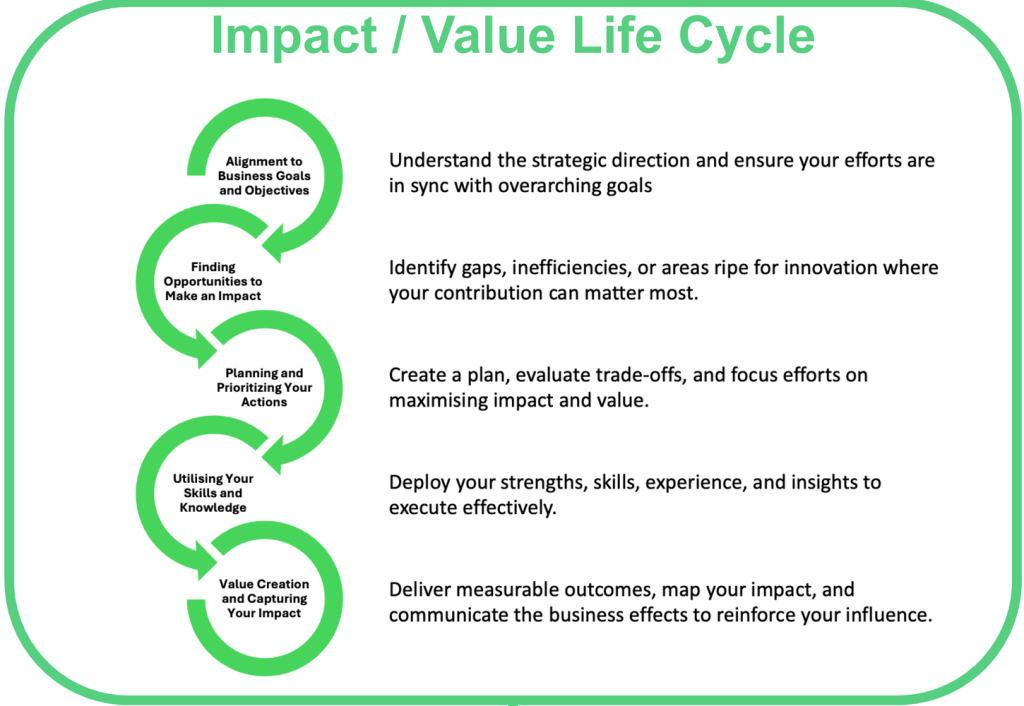
Once people understand how important impact is, and they have an understanding and alignment of the business objectives and goals, the next steps relate to the strategic side of this: Finding opportunities to make impact in alignment with those business objectives, and then starting to plan and prioritise some coherent actions.
There’s a magic formula for making an impact:

The Impact / Value Cycle captures this formula within its succinct stages. And the next challenge comes in how to show your work and the subsequent impact you are making.
Showing your work
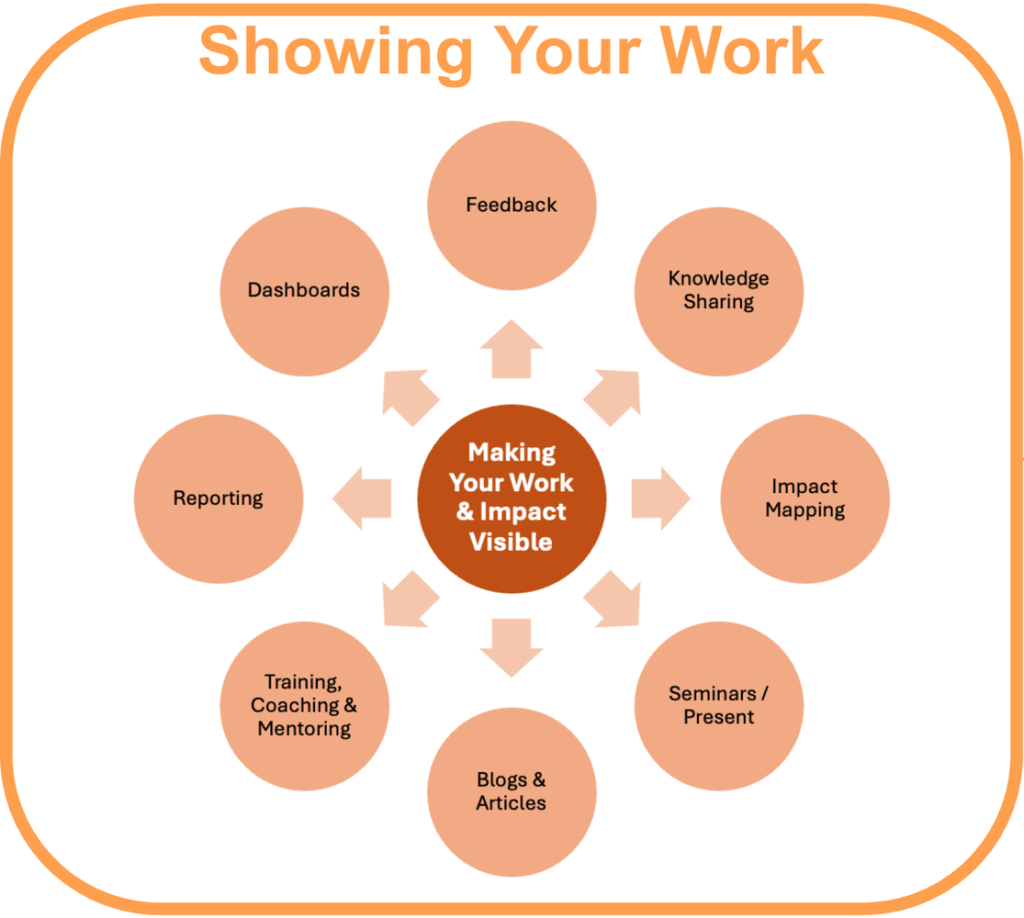
Trust doesn’t grow in the dark. If the impact you’ve made remains unseen, it becomes difficult for others to engage with your ideas with confidence. Gravitas is earned by making your value visible – not just in outcomes, but in the reasoning behind them.
When you document and share the positive changes you’ve driven, especially through people, you raise your profile, boost your credibility, and create clarity around your decision-making. This is essential when the problems you have solved (or are solving) are complex or abstract: transparency demystifies your choices and helps others build trust in your approach. By showing how your decisions are rooted in logic and experience, you create shared ground with stakeholders. That opens the door to collaboration, builds rapport, and aligns your work with what others care about.
Articulating your impact invites reflection: examining how that success came to be, and how it could be scaled or refined moving forward. It also enables you to gather feedback much more efficiently and effectively from your peers, your stakeholders, etc.
The cyclical nature of this model
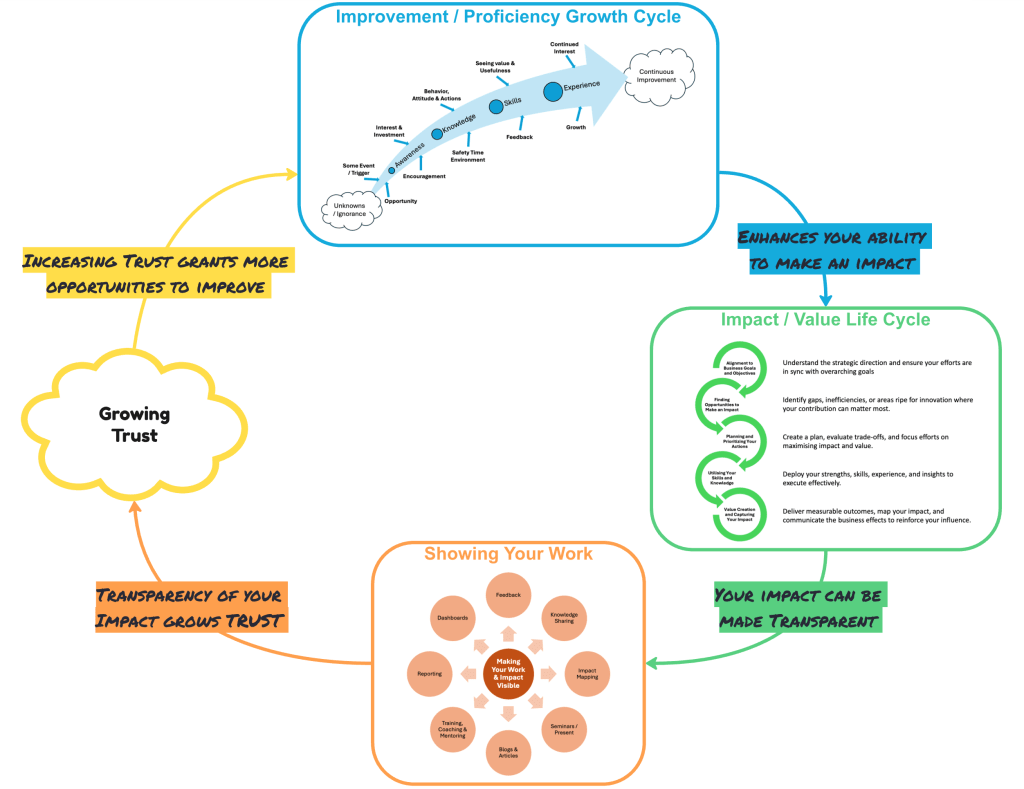
Progressing through the proficiency growth cycle, continuously improving your skills, experience and growth – it enhances your ability to make an impact. (Think back to the impact formula: part of that formula is in using your “Skills” underpinned by your knowledge and experience – this is the proficiency growth cycle!).
In making an impact, you connect them through to the business goals, in sync with the strategic direction. You then find those opportunities to improve things for people to give yourself some tactical focus and prioritisation. You then drive action in following through in making the impact, which you then capture and make as transparent as possible.
Doing so helps to grow trust. Which once you have grown, helps you improve more and opens up more opportunities to make further impact.
None of this is probably new, but it’s perhaps too implicit. It’s not spoken about enough by people. Growth is all too often seen as “complete some tasks -> seek the rewards”, but that kind of extrinsic motivation doesn’t last for long. And it certainly doesn’t build high performing teams that can build great quality products at pace.
 Evolving Leadership
Leave a comment