
The Real
Foundations
for Growth
Impact is the cornerstone of growth. Unlike checklist-driven progression that rewards titles, certifications, or peer comparisons, impact is about the tangible value you create. That value shows up in outcomes, influence, and the change you enable — for yourself, your team, your organisation, or even your industry.
Grounding growth in impact shifts the focus from chasing external validation to building intrinsic motivation. Impact connects directly to the key elements of growth:
- Impact Opportunities and Planning, strategically aligned with OKRs and KPIs
- Skills and Competencies you can map and track against your growth level
- Mastery across competencies and role expectations
- Evidence of the impact you’ve made, through impact mapping and a structured format that enables much fuller conversations about performance
- Feedback that deepens and validates your contribution
This foundation keeps career development stable and meaningful. Instead of being distorted by gamed frameworks or superficial metrics, growth is anchored in feedback, evidence, and the real difference you make.

Why Most
Growth
Frameworks
Fall Short
Task-driven growth frameworks often miss the real point of impact, leading to box‑ticking, peer comparisons, and destabilised expectations around promotion and reward.
Most growth frameworks miss the point on impact, motivation, and alignment with objectives. But rewards still usually go to those who create real impact or help achieve company goals, yet these frameworks still remain task-driven (“at this level, we expect you to do A, B, C”). This structure is uninspiring and easily leads to attempts at “gaming the system” through the box-ticking.
Coupled with performance reviews that try to move beyond tasks without clear evidence, this leads to “destabilised triangulation”, with people compared against peers or expecting promotion simply for completing similar tasks that others at higher levels also do. The root issue is treating growth as a checklist, wrongly assumed to guarantee pay rises or promotions.
The Seven Core Components of the Impact-Driven Growth Framework
The Impact Growth Framework brings structure, clarity, and intention to how people develop in their careers. Instead of relying on checklists, peer comparison, or vague expectations, it breaks growth down into seven core components that help individuals understand how they create value, how their skills evolve, and how their impact can be planned, mapped, evidenced, and amplified. Each component plays a distinct role, but together they form a complete system for navigating career progression with purpose, autonomy, and a clear sense of direction. This is growth grounded in impact, and it gives people a practical, repeatable way to shape their development and contribution over time.
The 7 core components of the Impact-Driven Growth Framework are:
The Impact Formula
The core mechanic for generating growth is the formula for making an impact:

The formula is the engine of the entire framework. It breaks impact down into three controllable components: the opportunities you step into, the skills you apply or grow, and the actions and behaviours you demonstrate. When these combine, they create impact that can be evidenced.
The formula shifts growth away from checklists and job titles, and toward a repeatable, intentional way of creating value. It also reinforces intrinsic motivation by connecting your work to autonomy, mastery, and purpose.
Opportunities:
These are situations and contexts that individuals have where impact can be made. People should have a level of autonomy to seek opportunities to make an impact, while managers and leaders have a responsibility to find and open up more opportunities for their people to make an impact.
Skills:
This is underpinned by knowledge and awareness, and relates to the craft, tech and business domains, the systems and strategies we work within, etc. Knowing what skills to grow and utilising your skills in effective, targeted ways enhance the level of impact you can make.
Actions:
Your actions are driven by your behaviour and attitude. How you show up, how you collaborate, the actions you plan and follow through with also affect your level of impact that you make.
Impact:
Finding the opportunities, utilising the skills, and taking the right actions with the right behaviours enables you to make an impact. Visualising and evidencing this has three major effects:
- It allows you to properly see and understand your impact, which gives you a much deeper sense of purpose within your role, stemming huge amounts of intrinsic motivation.
- It allows you to target your requests for feedback specifically on the impact you’ve made, to the people you impacted, which is much more valuable for your growth.
- It allows you to have much more deeper and meaningful (and less contentious) conversations in performance reviews, when it comes to seeking extrinsic rewards.
There are also two perspectives to take with this formula – a future proactive perspective, and a past reactive perspective:
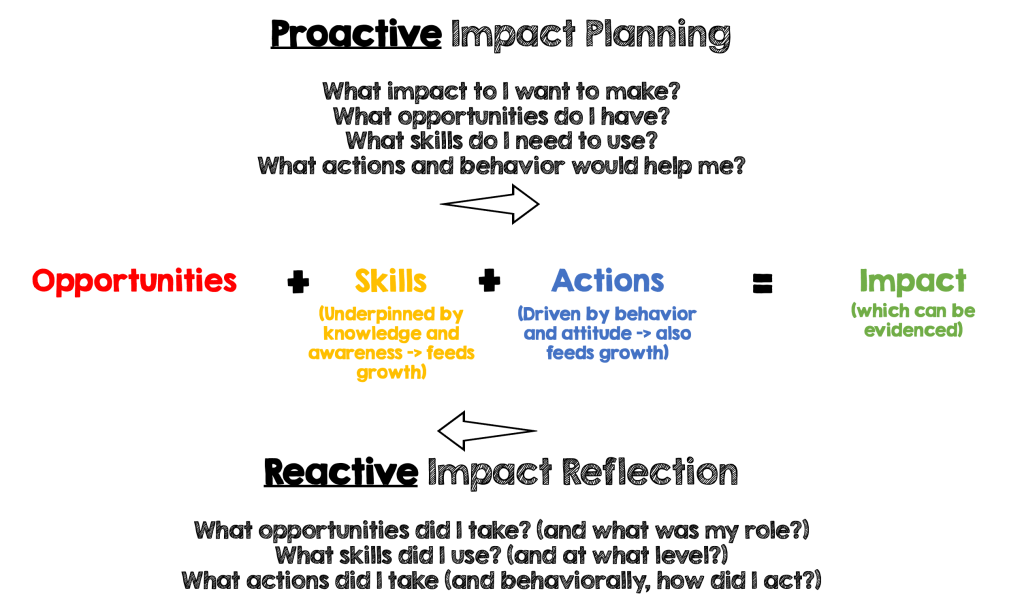
The perspective to take depends on which situation you are using the framework. If you are heading into performance reviews, then having to hand the reflective data on the impact you made, the opportunities and actions you took, the skills you utilised, and the feedback you collected, this all aids your conversation regarding your performance.
Whereas, if you have new company, team or personal objectives set, proactively planning what kind of impact you want to make, and mapping out the opportunities you have, the skills you need to gain and use, and thinking through some cohesive actions will support you in making and amplifying your impact.
Mastery Levels & The Growth Table Structure
This section defines the shared language of growth. The mastery levels (Remember → Evangelise, in the image below) blend Bloom’s Taxonomy of Learning with the Dreyfus Model of Skill Acquisition to show how skills deepen over time. The growth tables then map these mastery levels across role levels and competencies, making expectations transparent and scalable. This structure removes ambiguity, avoids peer‑comparison traps, and gives people a clear sense of what “good” looks like at each stage of their career.
The focus is on Mastery Levels instead of tasks
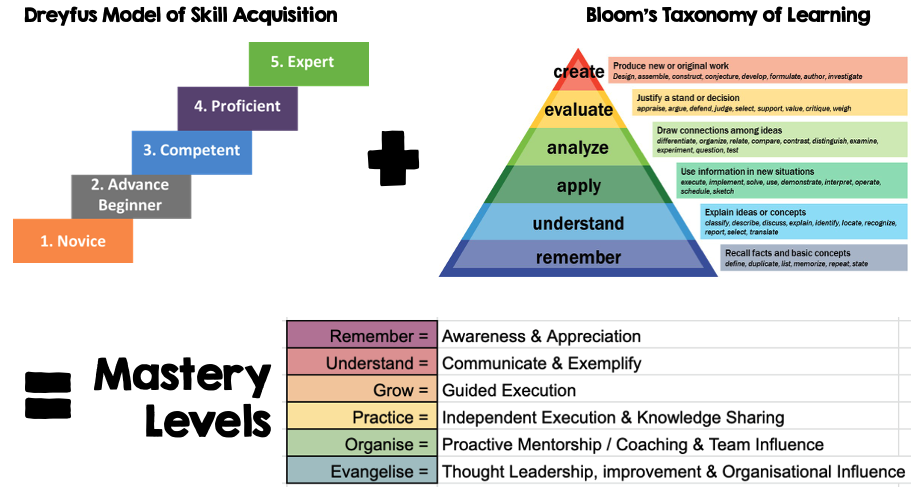
The framework isn’t built around “to operate at the next level, you must do A, B, and C.” Instead, using Mastery Levels within the growth table more directly defines the level of experience and maturity expected at each stage. This shift has several important effects:
- Mastery Levels reduce destabilised triangulation by removing the habit of comparing peers based on tasks, outputs, or checklists.
- They eliminate checklist‑driven behaviour entirely, which also removes the temptation to “game the system” for rewards.
- They give people a clear sense of where they are in their learning journey and what their next steps look like.
- They refocus growth on learning, which is the foundation of long‑term development.
- They enable stabilised triangulation, creating space for more targeted, meaningful, and actionable feedback.
Mastery Levels applied to Role Levels and Role Competencies
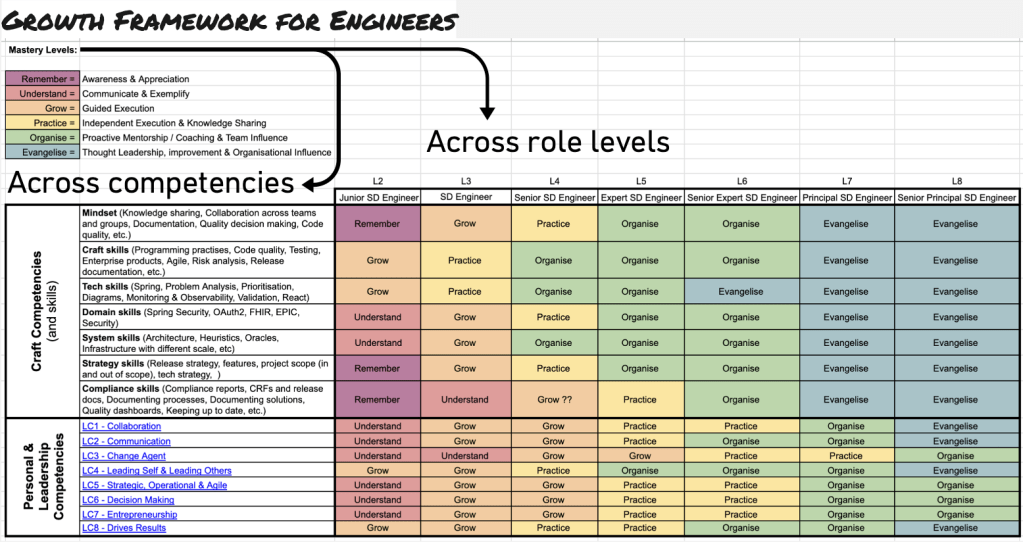
The table above shows an example of the role of an Engineer. Roles have various levels aligned to experience and maturity levels (i.e. Junior, Mid-level, Senior, Expert, Principle, etc) – these role levels are typically contextual to your organisation. Even the different types of roles themselves are contextual to your company needs. You might have Front-end Engineers and Back-end Engineers, or you might have Full-Stack Engineers, etc.
Additionally, each role has various competencies relating to the craft, and relating to personal and leadership traits. And each competency has a range of associated skills – these skills are context-driven in relation to your company’s business domain and technology domain. These competencies and skills will also be set contextually based on your organisations business domain, tech domain, etc.
The Mastery Levels are mapped in terms of expectations across each role level related to each competency related to the role. This way, the people in the role understand where they need to be in terms of mastery (maturity and ability).
Skills Mapping
Skills mapping is the diagnostic layer of the framework. It helps people understand where they currently sit in terms of capability, confidence, and mastery, and it highlights the gaps between where they are and where they want to be. By mapping skills against mastery levels, individuals can see which areas they’re already strong in, which areas need guided development, and which areas require deeper practice or organisational influence. It creates a shared, objective view between individuals and leaders, enabling more meaningful coaching, clearer expectations, and more intentional growth conversations.
Tina the Tester Model
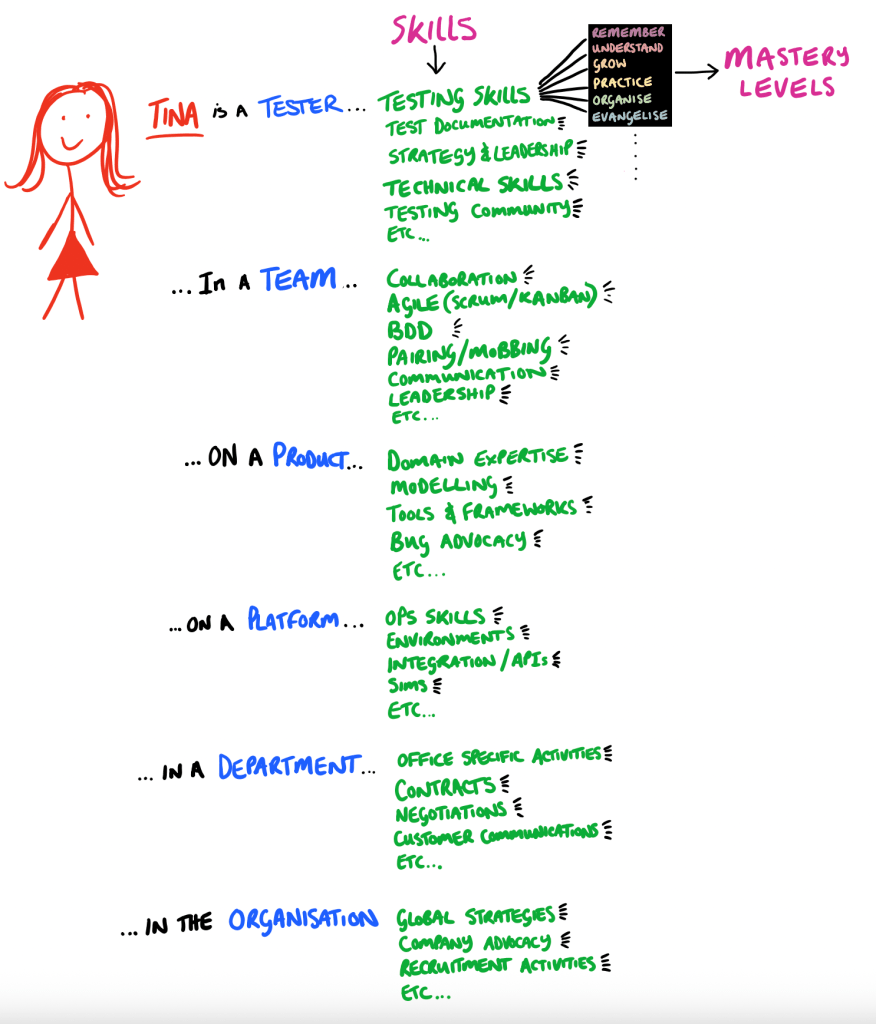
The “Tina is a Tester” model reinforces this by showing how a single role is made up of multiple layers: the role, the team, the product and platform contexts, the department, the organisation… Each with their skill and knowledge clusters: craft skills, tech skills, domain knowledge, system skills and knowledge, strategy and tactical skills, skills with tools & frameworks, environments, etc… Tina the tester may be strong in exploratory testing and risk analysis, but still developing in system‑level thinking or domain knowledge. Skills mapping makes this intentionally visible, to drive a learning pathway, and also to understand what skills you currently have to help you make the impact you are looking to make. It also shows that growth isn’t linear. Someone can be at “Practice” in one skill, “Grow” in another, and “Understand” in a third. This helps people avoid the trap of assuming they must be uniformly strong across every competency to progress.
Another important aspect is recognising when you’re operating above or below your role level. Skills mapping helps you see when you’re consistently performing work at a higher level of mastery or scope when you form a holistic view of your skills grouped by the overarching competency category, in relation to the scale of your impact. For example, influencing teams beyond your own, shaping strategy, or driving organisational improvements. But it also helps you spot when you’re over‑extending into areas that aren’t aligned with your role expectations or company priorities. This matters because role progression isn’t just about craft skills. It’s also about personal and leadership competencies: collaboration, communication, decision‑making, change agency, driving results, etc. These competencies often determine whether someone is ready for the next level, even if their craft skills are strong.
In short, skills mapping gives people a grounded, honest view of their capability across both craft and leadership dimensions. It helps them understand the level of work they’re currently operating at, the expectations of their role, and the areas they need to invest in to grow sustainably and intentionally.
Impact Planning
Impact planning is the proactive mode of growth. It encourages people to think ahead about the impact they want to create, the opportunities available to them, the skills they intend to use or develop, and the behaviours that will support their success. This shifts growth from reactive “what happened this quarter” thinking to intentional, strategic action. It’s where personal ambition meets organisational value.
Planned Impact Topics Canvas
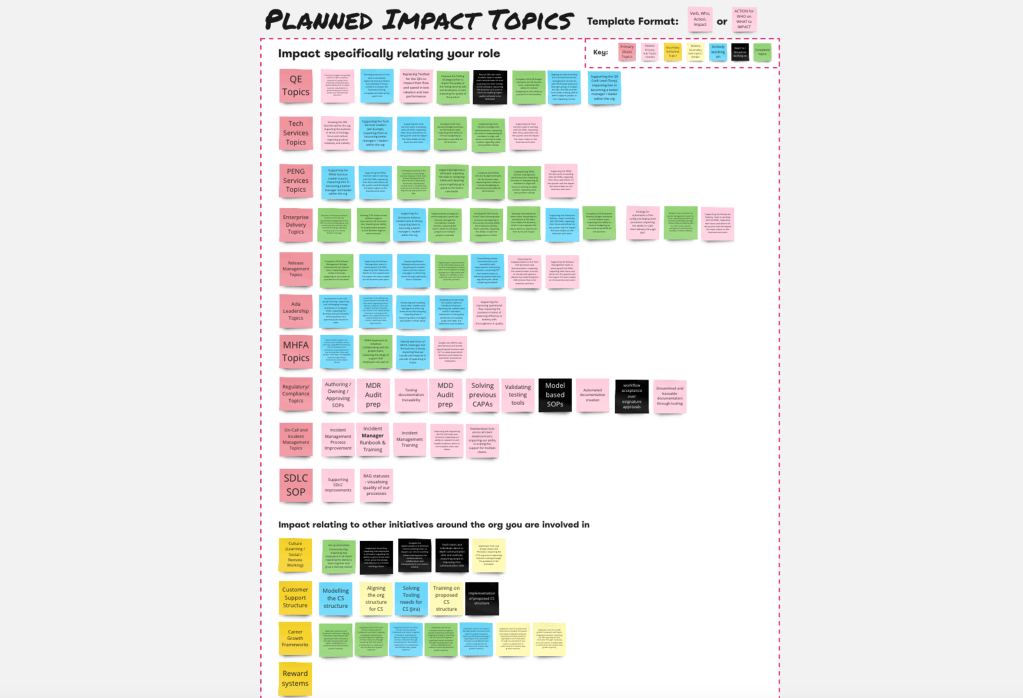
The “Planned Impact” section of the framework is ultimately a visual planning tool designed to make intended impact strategically visible. In the example above, the planned impact topics are structured into two distinct zones: the top half (pink tickets) captures impact directly related to your role, while the bottom half (yellow tickets) surfaces impact tied to broader organisational efforts you’re involved in beyond your role. This separation is intentional: it helps distinguish between core responsibilities and cross-functional contributions, while still treating both as valid and valuable sources of impact related to your growth.
The above example also shows a hierarchy, with the left hand tickets representing a thematic area (e.g. grouped by themes relating to topics ranging from QE, Tech Services, and Enterprise Delivery, to Culture Building, Career Frameworks, and Reward Systems). Within these rows, colour-coded sticky notes represent the individual impact topics being tracked. The colour key adds an additional layer of metadata, helping you track not just the impact topics, but also the status of them, which helps in understanding when to pivot in collecting evidence and feedback to help you grow further.
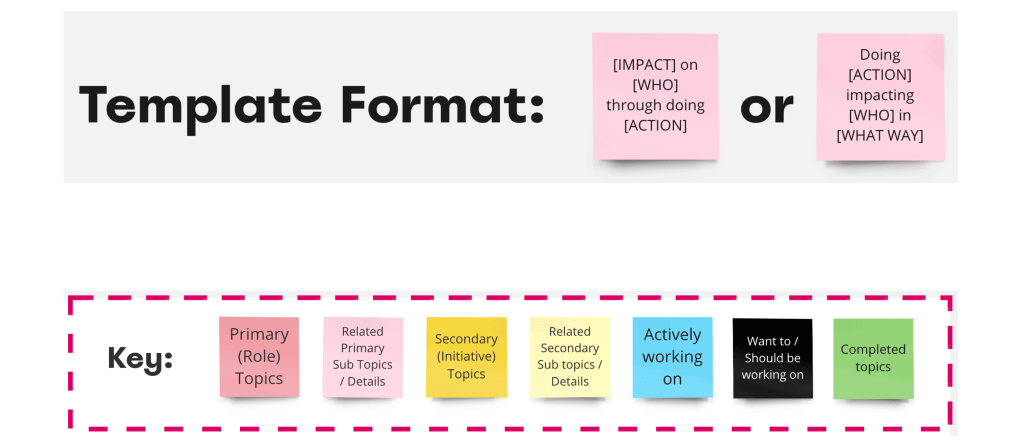
The tickets are also ideally templated to explain: what the impact is, on who, through doing what actions.
The intention of the format options is to help people think – it’s often easier to talk about the tasks and actions you are doing (thats what 99% of the growth frameworks you’ve used in the past have forced you to focus on talking about), so starting with that might be relatively easier. From there, you can progress in thinking about who you are impacting through those tasks: Is it yourself? Your team? Another team? An org area or domain? The whole company? Your customers/users/clients? The business? The industry or external communities? etc. And after you have detailed who you are impacting, the final thought is regarding in what way you are impacting them.
Thinking about and writing down the details of the impact you are making on people can be hard at first, as it seems rare to have thought about this if you have been operating in a task-based growth system for a long time. Sometimes it can be easier if you relate it to Objectives or Goals, if your company use OKRs (objectives and key results) or KPIs (key performance indicators). The following passage is an example of how Impact is the cherry on top of OKRs and KPIs, to help you detail the full narrative of the impact:
Let’s use swimming as our example.
Imagine you set yourself a bold personal objective: Become the fastest person to swim one length of an Olympic‑sized pool.
Great. We can turn that into a clear OKR.
- Objective: Become the fastest person to swim one length of an Olympic pool.
- Key Result: Beat the current world record — 20.91 seconds for men or 23.61 seconds for women.
So far, so good. Now we break this down into initiatives with KPIs that track your progress:
- Hire a training team – KPI: Bring in the right number of specialists with the right skills.
- Follow a structured training regime – KPI: Complete a specific number of reps, exercises, and sessions per day.
- Adopt a nutrition plan – KPI: Hit your calorie and food‑group targets consistently.
- Spend time in the pool – KPI: Achieve a set number of hours swimming each day.
Each KPI represents a level of performance that, if met, increases your chances of hitting the Objective.
This is the classic OKR system working exactly as intended.Now imagine you do it. You hit the time. You break the record!
You are officially the fastest person to swim one length of an Olympic pool! Amazing!!… But then what?Most people immediately look for extrinsic rewards: the bonus, the pay rise, the promotion. And sure, if those rewards come, they feel good… briefly. But they don’t sustain motivation into the next quarter. And if the reward doesn’t come, morale drops. Hard.
And here’s the reality: OKRs are usually quarterly. No company can hand out pay rises and bonuses every three months just because someone completed Objectives to the expectations specified in the Key Results.
So what keeps you going?
This is where impact becomes the cherry on top.Let’s rewind that celebration moment:
“YES! You’re the fastest person to swim one length of an Olympic pool! AND… look at the impact you’ve created:
- Your friends and family feel enormous pride after supporting you through the journey.
- Your training team gains reputation, credibility, and pride from helping you achieve something extraordinary.
- The next generation of children who witnessed what you just did are now inspired to get in the pool and learn to swim.
- Your competitors have witnessed that records can be broken, and are motivated to push harder and elevate their own performance to try to beat yours.
- You, yourself are impacted: your confidence, your reputation, your personal brand, your future opportunities, your sense of what’s possible. – you grow!
This is the part most people skip, but this is the part that actually fuels long‑term motivation, growth and ultimately that sense of purpose which brings happiness. Just going through this example, you can get a sense of how powerful it can be to shine a light on the impact you have on people from your actions. It really gives that deep sense of purpose.When you understand the impact your actions have on people, you tap into intrinsic motivation… The kind that lasts beyond a quarter, beyond a KPI, and beyond a bonus cycle.
Impact is what gives your work meaning.
Impact is what connects your effort to something bigger.
Impact is the cherry on top.
The Impact Planning structure is ultimately here to encourage proactive planning of the impact you want to make – that forward-looking future progression you are aspiring to make – identifying where you want to make a difference, and then aligning your skills, behaviours, and time accordingly. And as you make your impact, it becomes easy to manage the transition towards capturing the evidence of your impact you have made, and targeting feedback requests on the impact made, to the people who you have directly impacted too.
The board also reinforces the framework’s core principle: impact is not confined to your job title. By visualising contributions across different domains and initiatives, it validates the breadth of influence individuals can have. It also helps teams and leaders see how distributed efforts ladder up to strategic outcomes.
In short, this section turns abstract ambition into tangible, trackable action. It’s a living map enabling you to project manage your growth, planning and choosing your impact to make, and detailing how that impact translates into real-world value.
Impact Mapping
Impact mapping helps contextualise the value someone creates, and it gives you something that written lists and performance documents can’t: instant clarity.
A visual map turns abstract contributions into a pattern you can actually see. Instead of a scattered set of achievements, you get a structured picture of where your energy goes, where your strengths cluster, and where your influence is growing. It makes your work tangible. It makes your value visible. And it gives you a way to communicate your impact that lands immediately with others.
Mapping Impact Visibly
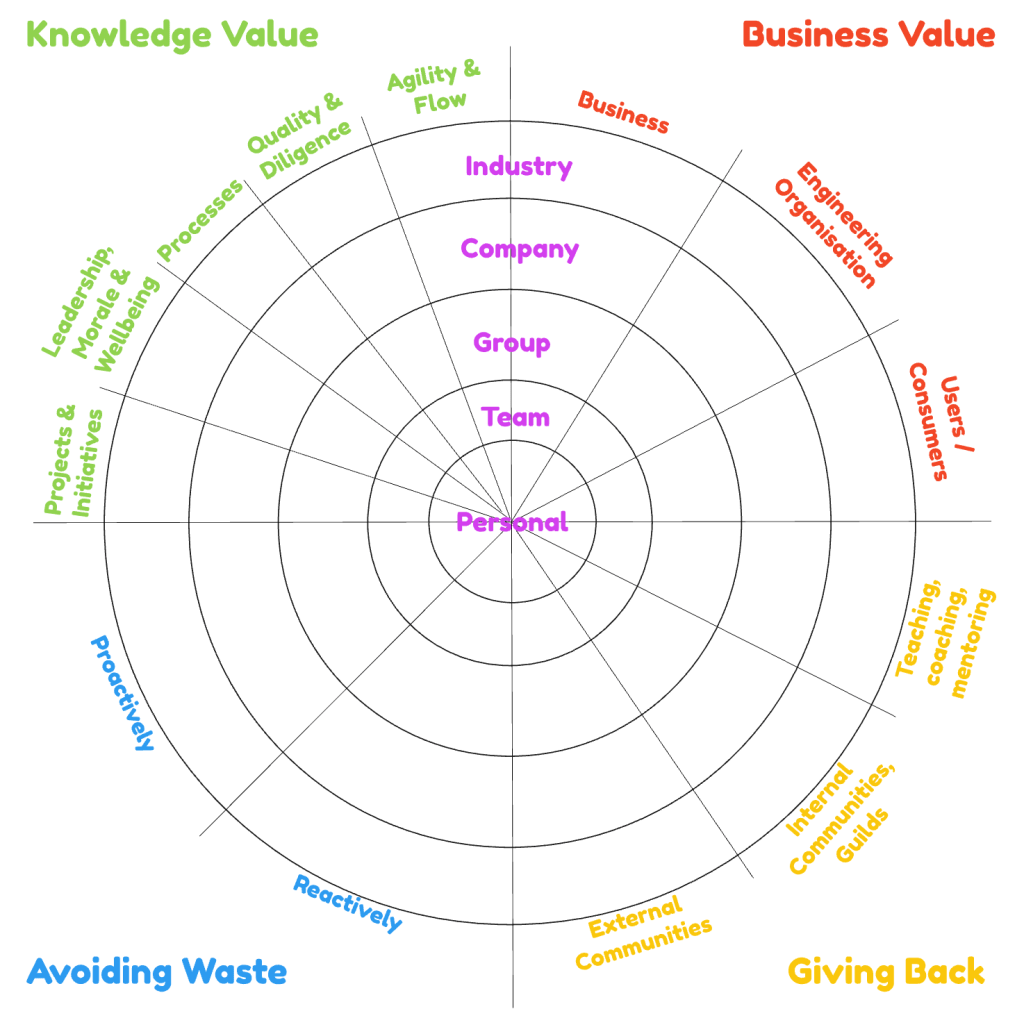
The impact map is designed to be a living, breathing snapshot of the value you create, and using it is far simpler than it looks at first glance. Start by placing your impact items (the things you’ve done, influenced, improved, or enabled, that are detailed on your Impact Plan) into the quadrants and segments that best represents the type of value they created. Knowledge Value, Business Value, Giving Back, and Avoiding Waste each capture a different dimension of contribution, so choose the one that reflects the primary nature of the impact.
Knowledge Value:
This quadrant is contextual to each type of role, meaning that the segments within this quadrant will be different across different roles, crafts or functions within the company. (E.g. for Engineers or Testers, appropriate categories are: Development & Tech, DevOps, Testing & Quality, and Agility & Flow. Whereas, for a Product Manager, appropriate categories would be: Product Ideation & Strategy, Planning & Roadmaps, Product Experimentation, etc).
Business Value
This quadrant helps to map and understand impact thats made on direct contributions to business outcomes, from the perspective of the business or org areas, consumers and users. For example: impacting revenue, client satisfaction, user experience, or commercial success, etc. This quadrant is also contextual in relation to the company rather than role. If the organisation contains different business domains or client engagements, these might be represented here.
Giving Back
This quadrant is for impact that relates to supporting others. For example: through mentoring, coaching, teaching, and community involvement (also split by internal communities and external communities).
Avoiding Waste:
This quadrant highlights impact relating to efficiency of processes: proactively avoiding waste, or reactively reducing it. This includes catching issues early, removing blockers, and reducing duplication.
Once you’ve thought about the quadrant and segment that the impact item would reside, choose the ring that reflects the scale of the impact: Personal, Team, Group, Company, or Industry. This is where the map becomes powerful. You’re not just listing achievements, you’re visualising the reach of your influence. Over time, you’ll start to see patterns: where your strengths cluster, where you naturally gravitate, and where you might want to stretch next. The map becomes both a reflection tool and a planning tool. It shows you the story of your impact at a glance, and it helps you get intentional about where you want that story to go next.
My own impact map
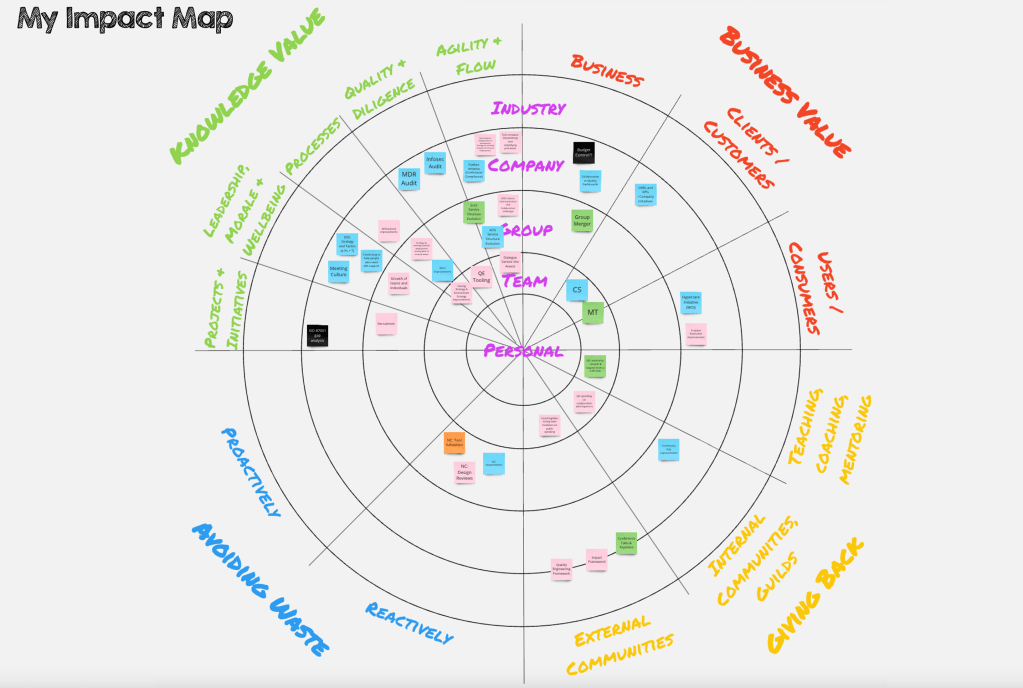
The radar-style map helps to reveal balance and imbalance in a way text never will. You can see at a glance whether your impact is concentrated in a specific quadrant (Knowledge Value, Business Value, Giving Back, or Avoiding Waste). You can see which segments within each quadrant you naturally gravitate toward and which ones you’ve neglected. You can see the scale of your impact (the circles depicting: personal level, team level, group level, company level, or industry level), whether your influence sits mostly at the personal or team level, or whether it’s expanding into group, company, or industry layers. That visual distribution becomes a diagnostic tool from the perspective of it enabling you to understand your growth, your blind spots, and your opportunities.
Because the map is structured around quadrants and concentric circles, it becomes a strategic planning tool as much as a reflection tool. You can deliberately choose where you want to grow next. You can plan impact across different quadrants and segments, shaping outcomes in the areas that matter most to your role and your aspirations..
Most importantly, a visual impact map gives you a story. When someone asks, “What impact have you had this quarter?” you’re not scrambling for examples. You can point to a clear, coherent picture that shows the breadth and depth of your contribution. It’s a way of saying, “This has been my impact and purpose, this is how I operate, and this is the difference I make,” all in a single glance.
Evidencing Impact
One of the biggest challenges in career growth is proving the value you create. Most people can list tasks they’ve completed, projects they’ve touched, or responsibilities they’ve held. But that’s not the same as demonstrating impact. Impact is about the change you caused — the difference your work made to people, teams, systems, or outcomes. And unless you capture that evidence deliberately, it disappears into the noise of day‑to‑day delivery.
Evidencing impact turns work into a clear, traceable story about value. It captures what was done, how it was done, who it affected, and what changed as a result. This section of the framework provides structure for documenting impact in a way that is meaningful, defensible, and aligned with the mastery levels. It gives you language for performance reviews, promotion cases, interviews, and strategic conversations, and helps to support fair performance reviews. And most importantly, it helps you evidentially see the real influence you have on the world around you.
A Table for Evidence
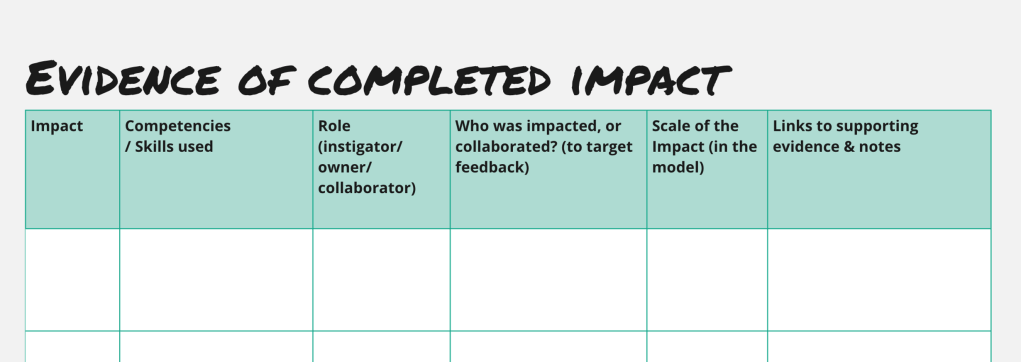
Evidencing your impact is the practice of documenting the details of the impact you’ve achieved in a structured way, linking to the your output that enabled the impact.
The table in the image above shows the type of things useful to any growth conversations:
1. Describe the Impact Itself
This is the headline. What was the change you created? Keep it short, specific, and outcome‑focused. Ultimately, this is the information that you have in your post-it notes from the Impact Planning section of the framework, with some added clarity/details if required.
2. Identify the Competencies and Skills You Used
This relates back to the growth table and the skills mapping sections of the framework. You map the impact to the skills and mastery levels you demonstrated: craft competencies and skills, and leadership/personal competencies and skills. This connects your impact to your development and shows how you operated, not just what you did.
3. Clarify Your Role: Instigator, Owner, or Collaborator
This offers clarity in your operational level for the topic, and prevents any misunderstandings in over‑claiming or under‑claiming the responsibility for the impact.
- Instigator: you initiated the idea or opportunity.
- Owner: you drove it end‑to‑end as the decision maker.
- Collaborator: you were a key, meaningful contributor alongside others.
This distinction matters, especially in cross‑functional environments. It also helps when it comes to collecting feedback from peers regarding the role you played in making the impact.
4. List Who Was Impacted or Involved
This is your input into requesting feedback. These are the people who can speak to the value of your work, based on the impact they felt from your work. When you later ask for feedback, you’re not asking for generic praise – it’s a whole new level of feedback you can obtain, as you’re asking for reflections on a specific, real impact felt.
5. Capture the Scale of Impact
This relates to circular levels depicted in the visual impact map/radar. Was this personal? Team‑level? Group‑level? Company‑wide? Industry‑wide?
This also ties directly into seniority expectations and helps you see and show how your influence is expanding and growing over time.
6. Link to Supporting Material
This is the grounding layer, as it offers something to point to regarding what you did that caused the impact. It could be:
- Code repos and pull requests
- Release notes
- Dashboards
- Quality metrics
- Documents
- Tickets
- Presentations
- Feedback messages
- Metrics
- Before/after snapshots
- etc…
For example: if you’ve impacted users through implementing a new feature in the product, then links to the codebase, release notes are relevant, and user feedback about the feature are all relevant… Or if you’ve impacted a team through teaching them something in a workshop session, then links to the workshop slides, attendee info and feedback, and links to secondary information showing the team using what they learned is all relevant).
Evidence turns a claim into a fact.
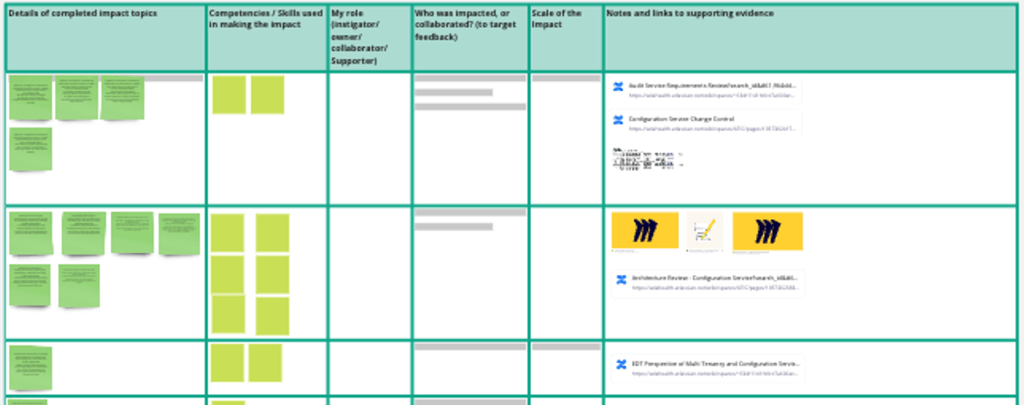
Why this matters
When you evidence your impact, you create a defensible, compelling narrative of your value. You’re no longer relying on memory, luck, or someone else noticing your work. You’re building a body of proof that shows how you think, how you operate, and how you create change.
This shifts performance conversations from opinion to evidence. It strengthens promotion cases. It gives you confidence in interviews. It reveals patterns in your strengths and growth areas. And it fuels intrinsic motivation because you can literally see the positive difference you’re making and feel a true sense of purpose.
Most importantly, evidencing your impact helps you grow with intention. You stop drifting through tasks and start shaping a career built on meaningful, visible, and scalable impact.
Feedback on Impact
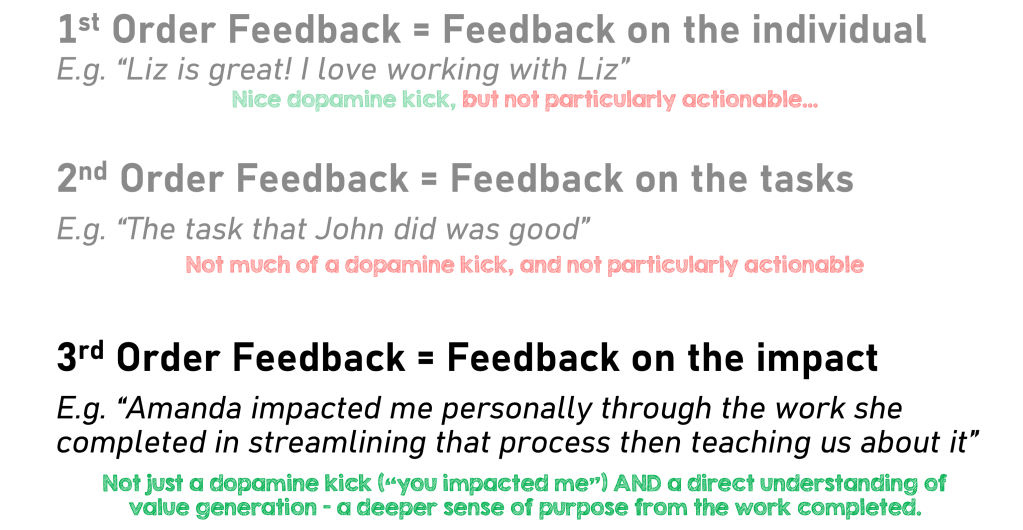
In any growth framework or performance review process, feedback has always been intended as a tool for growth… But the difference with the Impact-Driven Growth Framework is that it turns feedback into a reflection of the impact you made, which goes far beyond the typical type of feedback people usually give if asked generically, on how they felt about working with you, or how they felt about a task you did. Feedback on concrete impact, makes it targeted, actionable, and directly tied to your development.
in the context of this framework, I distinguish between 1st‑order feedback (which focuses on the person), 2nd‑order feedback (which focuses on the task the person did), and 3rd‑order feedback (which focuses on the impact felt from the thing the person did). Making this distinction raises the quality of the request for feedback, and the quality of the feedback received. And it subsequently improves growth conversations and reinforces intrinsic motivation. 3rd-order feedback helps people understand not just what they did, but the value it created and how they can amplify it.
Logistically, feedback can be received in many different avenues – most HR teams have tools to help people request and share feedback. Many people ask for feedback on common communication channels too, such as Slack or email, or even face to face or in 1:1 calls.
Adding feedback from any of these avenues visibly next to your evidences allows you to directly connect the feedback to the impact points.
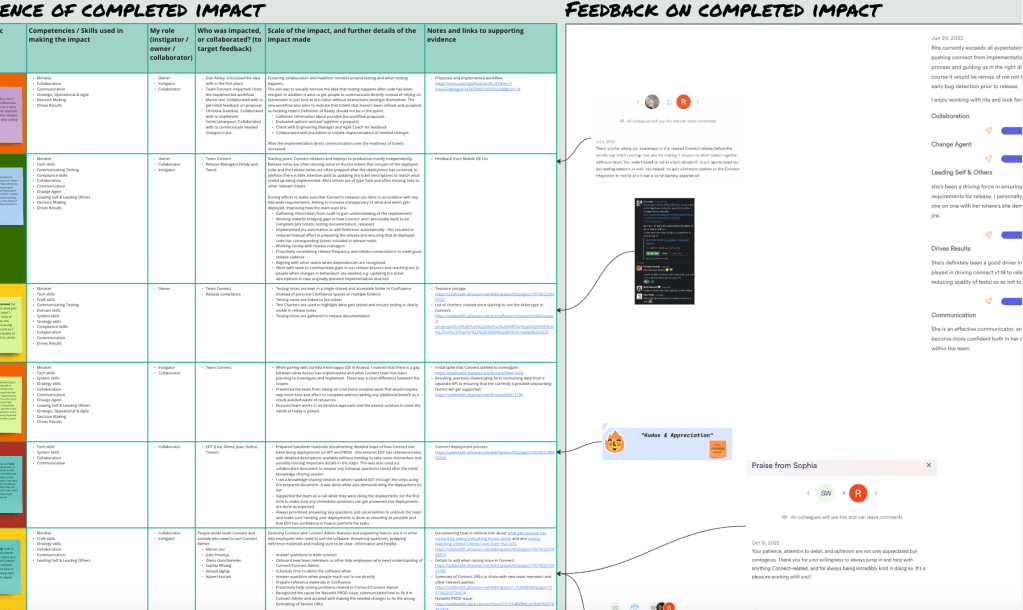
When you visibly connect feedback to your impact evidence, you close the loop between intention, action, and outcome. It validates the story you’re telling with real voices and real experiences, and it strengthens the credibility of your impact narrative. This is how feedback becomes transformative.
Over time, this creates a powerful rhythm: you plan impact, you deliver it, you evidence it, and the people affected by it help you articulate its value.
Conclusions
The holistic, impact‑driven growth framework brings all the pieces together: your skills, your behaviours, your opportunities, your actions, and the real‑world change you create.
It shifts the focus away from checklists, job titles, and arbitrary expectations, and instead centres your growth on something far more meaningful: the value you bring to people, teams, and organisations. When you map your impact, evidence it, and connect it to feedback, you build a living, breathing picture of who you are as a professional and how your influence is evolving.
This approach is useful because it gives you clarity. It shows you where you’re strong, where you’re growing, and where you can stretch next. It gives you language for performance conversations, confidence in interviews, and a grounded narrative for promotions. But more importantly, it gives you purpose. You can truly see the difference you’re making to people.
And this is where strategy comes in. Growth doesn’t happen by accident. When you understand the landscape of your impact, you can choose where to invest your energy. You can plan the kind of impact you want to make, seek out the opportunities that align with it, and deliberately build the skills that will get you there. Instead of waiting for growth to happen, you architect it! You become intentional, directional, and empowered, shaping a career defined by the impact you choose to create.
Want to get strategic about your growth? We offer coaching and mentoring services.
Or contact us today to discuss your needs.
Join our subscribers
Stay in the loop with new articles, videos, and frameworks.
 Evolving Leadership